

For sauna users in Quebec and across Canada, temperature is normally measured in Celsius. The Rule of 200, however, is based entirely on Fahrenheit.
That makes the basic conversions important from the beginning:
- 160°F is approximately 71°C
- 170°F is approximately 77°C
- 180°F is approximately 82°C
- 190°F is approximately 88°C
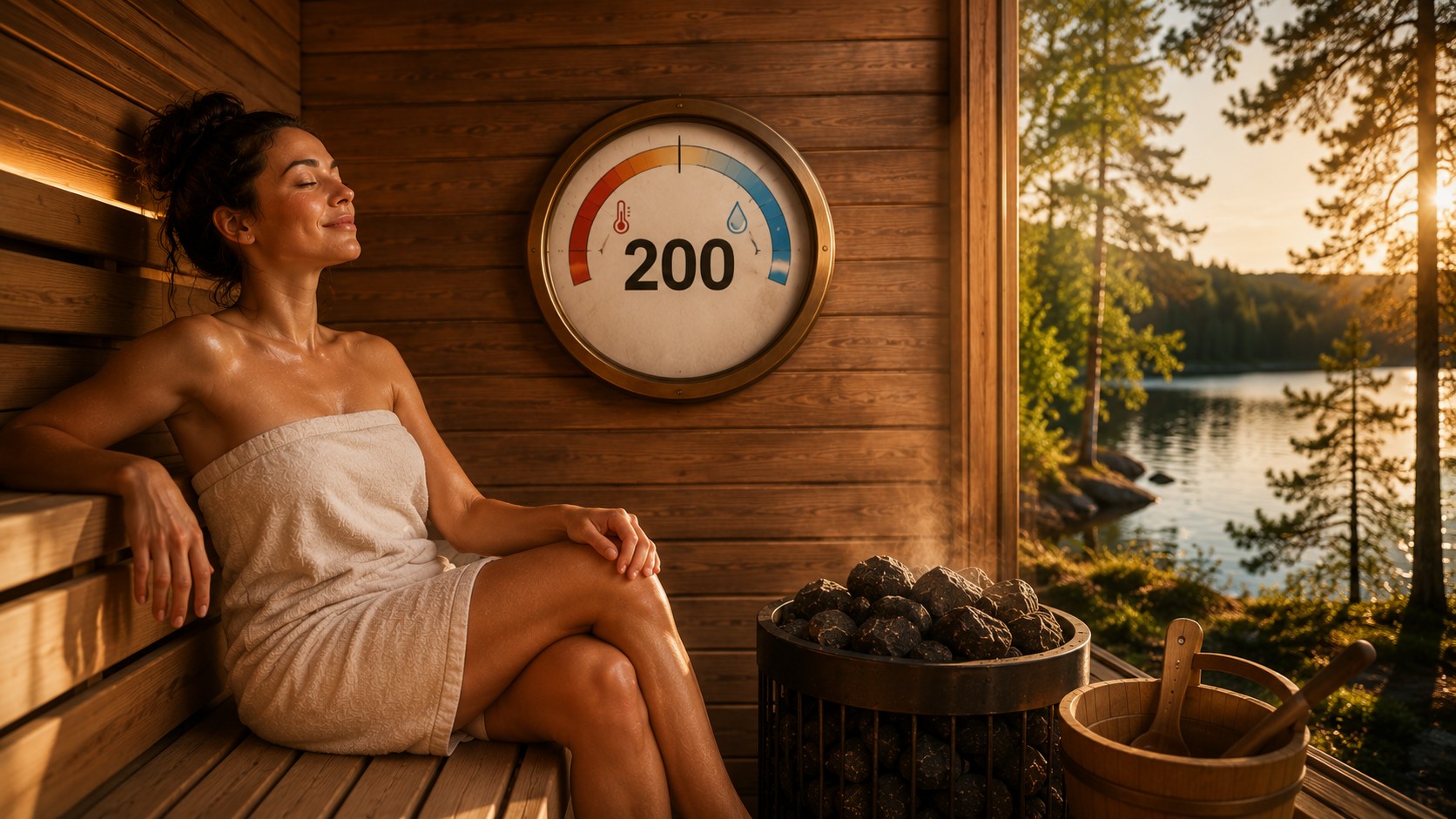
The Rule of 200 is a simple sauna guideline suggesting that the temperature in degrees Fahrenheit and the relative humidity percentage should add up to approximately 200.
For example:
180°F, or approximately 82°C, plus 20% relative humidity equals 200.
The rule communicates one useful idea: sauna temperature cannot be fully understood without considering humidity. Adding water to properly heated sauna stones can make the heat feel substantially more intense, even when the thermometer barely changes. However, the Rule of 200 is not a scientific safety standard, a medical recommendation or a formally recognized Finnish sauna rule. Two sauna environments that both total 200 can feel very different.
The best way to use it is as a starting point for understanding sauna temperature, humidity and löyly, not as a number that must be reached.
Sauna Lifestyle Youtube Episode on Sauna Rule of 200
Quick Answer: What Is the Rule of 200?
The Rule of 200 uses this formula:
Sauna temperature in °F + relative humidity percentage = approximately 200
| Fahrenheit | Approximate Celsius | Required Relative Humidity to Hit 200 |
|---|---|---|
| 160°F | 71°C | 40% |
| 170°F | 77°C | 30% |
| 180°F | 82°C | 20% |
| 190°F | 88°C | 10% |
All four examples produce the same mathematical total. They do not produce identical sauna conditions. A sauna at 190°F and 10% relative humidity is hotter and comparatively dry. A sauna at 160°F and 40% relative humidity is cooler but substantially more humid. The way the body gains and releases heat can differ considerably between those environments. That distinction is the most important limitation of the Rule of 200.
What Is the Idea Behind the Rule of 200?
The Rule of 200 attempts to describe the relationship between heat and moisture:
- As sauna temperature increases, less humidity may feel comfortable.
- As humidity rises, a lower air temperature may still feel intense.
- A hot, dry sauna can feel different from a cooler sauna with more frequent löyly.
- Temperature alone does not describe the complete sauna experience.
The underlying principle is valid.
A 2026 study published in the scientific journal Temperature found that air temperature and relative humidity independently influenced cardiovascular and thermoregulatory responses during Finnish sauna bathing. Temperature generally had the stronger effect, but humidity also contributed to the body’s response. The complete study is available in Temperature and Humidity Independently Influence Thermoregulatory Responses During Finnish Sauna Bathing. The study supports the idea that both temperature and humidity matter. It does not establish that the two measurements can be combined into one scientifically meaningful total of 200.
Is the Rule of 200 Really Finnish?
The Rule of 200 is regularly described online as the “Finnish Rule of 200.”
That description should be treated cautiously. First, Finland uses Celsius rather than Fahrenheit. A traditional Finnish rule would be unlikely to depend on adding a Fahrenheit temperature to a percentage. Second, primary Finnish sauna resources do not appear to present the Rule of 200 as a recognized cultural, technical or safety standard. The Finnish Sauna Society describes the heater as the heart of the sauna. It explains that the heater warms the sauna and its bathers while the heated stones turn water into steam. It does not define good sauna conditions through a Rule of 200 calculation.
The Finnish cultural resource Bare Facts of the Sauna in Finland describes sauna temperature as a matter of preference. It notes that the Finnish Sauna Society commonly recommends approximately 80°C to 100°C, or 176°F to 212°F, while emphasizing that sauna bathing should not become a competition to tolerate the greatest possible heat.
Harvia, one of Finland’s best-known sauna-heater manufacturers and SaunaSpa trusted suppliers, also states that there is no single correct sauna temperature. At higher temperatures, löyly may feel sharper. At lower temperatures, additional water can create a softer and more humid experience. Read Harvia’s guidance on choosing the correct sauna temperature.
Based on the available evidence, the most accurate conclusion is:
The Rule of 200 is better understood as a modern, Fahrenheit-based rule of thumb than as an official Finnish sauna tradition.
It reflects a genuine feature of Finnish-style sauna bathing, namely the interaction between temperature, moisture and löyly. The specific mathematical formula does not appear to be an established Finnish standard.
Why Does Humidity Make a Sauna Feel Hotter?
The human body regulates temperature partly by producing sweat. Sweating alone does not cool the body. Cooling occurs when sweat evaporates from the skin. When the surrounding air becomes more humid, sweat cannot evaporate as efficiently. The body has greater difficulty releasing heat, and the environment may feel more intense.
Environment and Climate Change Canada explains this principle in relation to humid weather. Sweat cannot cool the skin as effectively when it cannot evaporate quickly, which is why humid conditions can feel hotter than dry conditions at the same temperature.
Health Canada’s technical guidance on heat exposure similarly explains that high humidity impedes evaporative cooling and can contribute to thermal strain when combined with high temperatures. Sauna conditions are substantially hotter than normal outdoor weather, but the underlying physiological principle remains relevant.
In a relatively dry sauna:
- Sweat may evaporate more readily.
- Very hot air may feel dry or sharp.
- Heat still reaches the body through the air, heater, stones and surrounding surfaces.
When water is poured onto properly heated sauna stones:
- Humidity rises quickly.
- Sweat evaporation becomes less efficient.
- Moist heat reaches the skin.
- The perceived intensity may increase almost immediately.
- The thermometer may show little or no immediate change.
This is why a relatively small amount of water can significantly change how the sauna feels without materially increasing the measured air temperature.
What Is Relative Humidity?
Relative humidity is frequently misunderstood. It does not simply tell us how much water is present in the air. It describes how much water vapour is present compared with the maximum amount the air could hold at that particular temperature. Warm air can contain substantially more water vapour than cool air. For that reason, 20% relative humidity inside a sauna is not comparable to 20% relative humidity inside a home at normal room temperature.
It also means that:
40% relative humidity at 71°C is not equivalent to 10% relative humidity at 88°C.
Although both combinations produce a Rule of 200 total, the moisture conditions, evaporation rate and heat-transfer experience are different. This is one of the principal scientific weaknesses of the Rule of 200. The formula treats each humidity percentage as though it has the same physical meaning at every temperature. It does not.
What Is Löyly?
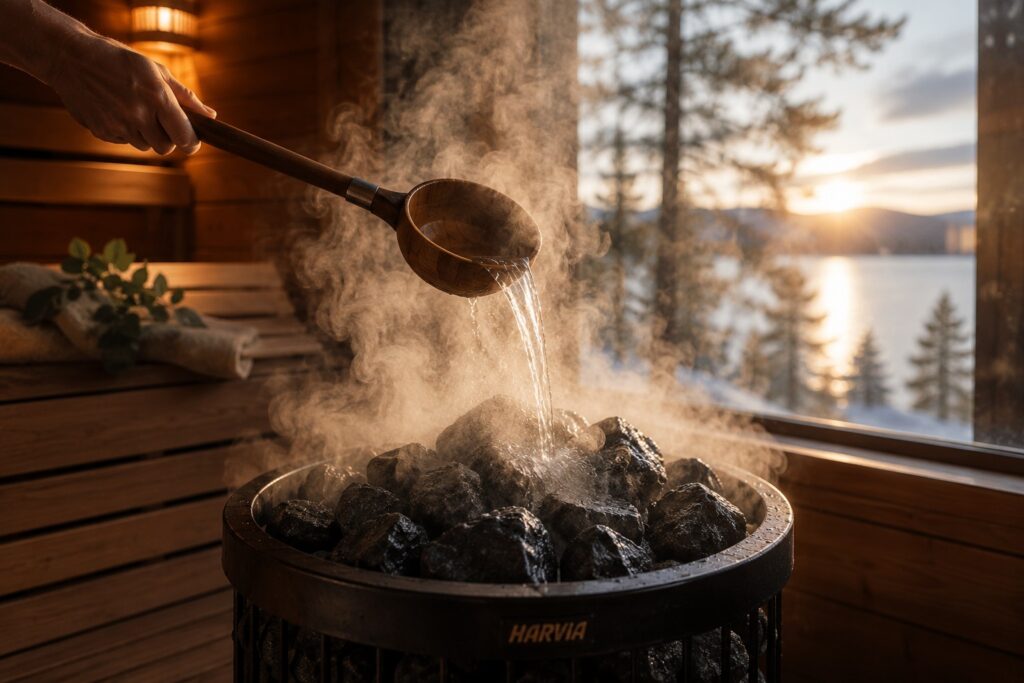
Löyly is a Finnish word generally used to describe the wave of heat and moisture produced when water is poured onto hot sauna stones. It is often translated simply as “steam,” but the concept is broader than water vapour alone. Löyly describes the changing sensation that moves through the sauna after water touches the stones.
The basic process is:
- Water is poured onto properly heated sauna stones.
- The water is rapidly heated and vaporized.
- Hot moisture moves through the sauna.
- Relative humidity rises.
- A wave of heat reaches the bathers.
- Humidity gradually decreases through ventilation, absorption and condensation.
The Finnish Sauna Society explains that the heater warms the room and bathers while the stones convert the added water into steam. The quality of löyly depends on more than the temperature displayed on the wall. It may be affected by:
- Heater design and output
- Temperature of the stones
- Quantity and arrangement of the stones
- Amount of water used
- Interior sauna volume
- Bench height
- Air circulation
- Ventilation
- Wood and glass surfaces
- Distance between the bathers and the heater
A good sauna experience is therefore dynamic. Humidity rises after water is added, the wave of löyly moves through the room and conditions gradually return toward their baseline. A traditional sauna does not need to maintain one exact humidity reading throughout the session.
SaunaSpa Expert Tip
In our experience building saunas for Canadian winters, new owners often rush to pour water as soon as the air thermometer reaches 80°C. For better löyly, allow the stones additional time to become fully heated. In many SaunaSpa installations, this may mean waiting another 15 to 20 minutes. Underheated stones may produce weak, heavy moisture rather than the clean wave of löyly owners expect, regardless of what the wall gauge shows.
The precise heating time varies according to the heater, stone mass, sauna size, glass area and outdoor temperature. Harvia similarly advises allowing a sauna to heat properly before adding water and notes that air temperature can rise before the stones have stored sufficient heat for effective löyly. (Harvia – Healing with Heat)
What Are Normal Sauna Temperature and Humidity Levels?
A 2024 scientific review describes Finnish sauna bathing as commonly involving temperatures of approximately 80°C to 100°C, or 176°F to 212°F, with relative humidity generally around 10% to 20% before or between additions of water. The review is available through PubMed: The Multifaceted Benefits of Passive Heat Therapies for Extending the Healthspan. These figures describe conditions commonly reported in sauna research. They are not mandatory settings for every sauna user. Humidity rises temporarily when water is poured onto the stones. The intensity and duration of löyly depend on:
- Heater design
- Stone temperature and mass
- Room size
- Ventilation
- Quantity of water
- Bench position
Many people also prefer lower-temperature sauna sessions.
Harvia explains that:
- At approximately 80°C to 100°C, the air may feel dry and the löyly may feel sharper.
- At approximately 50°C to 60°C, additional water can create a softer, more humid experience.
- Lower-temperature, higher-humidity bathing generally works best with a heater containing a substantial amount of properly heated stones.
There is no universally correct combination for every user.
What the Rule of 200 Gets Right
Although the Rule of 200 is not a scientific formula, it teaches several useful lessons.
Temperature Alone Is Not Enough
Knowing that a sauna is heated to 82°C, or 180°F, does not fully explain how it will feel. The same room can feel substantially more intense immediately after water is poured onto the stones. Current research supports the broader conclusion that temperature and humidity independently affect the body’s response during sauna exposure. (Taylor & Francis Online)
Lower Temperature Does Not Always Mean a Gentler Experience
A lower-temperature sauna with considerably higher humidity can still produce an intense experience. This also helps explain why a steam room can feel extremely hot despite operating at a much lower air temperature than a traditional Finnish-style sauna.
Humidity Should Be Adjusted Gradually
Adding more water does not simply make the air feel less dry. It changes how heat reaches the skin and how effectively sweat can evaporate. A modest amount of water can produce a noticeable wave of löyly.
Personal Preference Matters
Some people prefer hotter, drier air with smaller amounts of water. Others prefer lower temperatures with softer and more frequent löyly. Neither preference is automatically more authentic. The better setting is the one that creates a comfortable and enjoyable sauna experience for the individual user.
Why the Rule of 200 Is an Oversimplification

It Combines Two Different Measurements
Degrees Fahrenheit measure temperature. Relative humidity is a percentage describing atmospheric moisture in relation to the maximum amount the air can hold at a particular temperature. Adding the two creates a memorable number, but not a recognized physical measurement.
The Rule of 200 is not equivalent to a scientifically defined index such as Canada’s Humidex. Humidex uses a meteorological calculation to represent the combined effect of heat and moisture rather than simply adding air temperature and relative humidity.
Different Combinations Can Feel Very Different
Consider:
- 190°F, or 88°C, with 10% humidity
- 160°F, or 71°C, with 40% humidity
Both total 200.
The first environment is hotter and drier. The second is cooler but substantially more humid.
They may differ in:
- Sweat evaporation
- Actual moisture content
- Condensation
- Breathing sensation
- Heat transferred to the skin
- Thermoregulatory demand
- Personal comfort
A matching mathematical total does not make the experiences equivalent.
Humidity Is Constantly Changing
Humidity can rise sharply after water is poured onto the stones and then decline as:
- Moisture moves through the room
- Wooden surfaces absorb moisture
- Vapour condenses on cooler surfaces
- Air is exchanged through ventilation
- The sauna door opens
A hygrometer may also respond more slowly than the actual wave of löyly. Trying to maintain an exact Rule of 200 calculation throughout a session is neither practical nor necessary.
Gauge Placement Affects the Reading
Heat rises inside a sauna. A thermometer positioned close to the ceiling may record a higher temperature than one installed closer to a lower bench. Readings can also vary depending on proximity to:
- The heater
- The door
- The fresh-air intake
- The exhaust vent
- Large glass surfaces
A thermometer and hygrometer can help users understand how their sauna behaves, but ordinary consumer instruments should not be treated as laboratory equipment. Install them according to their manufacturer’s instructions and use them to observe consistent patterns from the same location.
It Ignores Radiant Heat
The body receives heat not only from the surrounding air but also from:
- The heater
- Sauna stones
- Wooden walls
- The ceiling
- Glass
- Other heated surfaces
Someone sitting closer to the heater may experience more radiant heat than someone farther away, even though both see the same wall-mounted readings.
It Ignores Ventilation
Ventilation affects:
- Fresh-air supply
- Movement of heat
- Distribution of löyly
- Differences between upper and lower bench temperatures
- Removal of moisture after use
- How fresh or stuffy the room feels
A sauna with inadequate airflow may feel uneven or uncomfortable even when the displayed temperature and humidity produce a total of 200.
It Ignores the Heater and Stones
The heater must be appropriately matched to the sauna’s interior volume and materials. The sauna stones must also contain enough stored heat to vaporize water effectively. A high air-temperature reading does not necessarily mean the stones are ready to produce satisfying löyly. The Finnish Sauna Society identifies the heater and stone system as central to the sauna experience. Harvia also warns that an oversized heater may warm the room too quickly without giving the stones sufficient time to store heat. (Sauna)
It Ignores the Individual User
People respond differently to heat. Comfort and heat tolerance may be affected by:
- Age
- Health
- Sauna experience
- Hydration
- Medications
- Recent exercise
- Session duration
- Bench position
- Amount of water used
- How the person feels that day
A setting that feels comfortable during one session may feel overly intense during another.
Is the Rule of 200 a Safety Rule?
No.
There is no established scientific evidence showing that a total below 200 is automatically safe or that a total above 200 is automatically dangerous. The Rule of 200 does not account for:
- Length of exposure
- Repeated sauna rounds
- Cooling periods
- Hydration
- Alcohol consumption
- Medical conditions
- Medications
- Pregnancy
- Age
- Recent illness
- Individual heat tolerance
The calculation should never be used to justify remaining inside when the sauna no longer feels comfortable.
Leave the sauna if you experience:
- Dizziness
- Nausea
- Unusual weakness
- Confusion
- Feeling faint
- Chest discomfort
- Unusual shortness of breath
- Overwhelming heat
Health Canada identifies dizziness, weakness, nausea and other symptoms as possible warning signs of heat-related illness. People with medical conditions, heat sensitivity or uncertainty about sauna use should seek guidance from a qualified healthcare professional. (Canada)
Sauna heat should never become a competition.
For more guidance on session length and cooling breaks, read How Long Should You Stay in a Sauna?.
How to Use the Rule of 200 Practically
The Rule of 200 is most useful as an educational reference.
Heat the Sauna Properly
Allow enough time for:
- The sauna air to warm
- The stones to store heat
- The benches and surrounding surfaces to warm
- The interior temperature to stabilize
Do not rely solely on the first high reading displayed by the thermometer.
Begin at a Comfortable Temperature
New sauna users do not need to begin at the upper end of the traditional Finnish range. Start at a temperature where you can sit comfortably and breathe normally without feeling challenged by the heat.
Observe the Baseline Humidity
Look at the hygrometer before adding water. Remember that the reading is approximate and may respond slowly to a sudden change in humidity.
Add Water Gradually
Only pour water onto a heater specifically designed to contain sauna stones and produce löyly. Follow the heater manufacturer’s instructions. Never pour water onto infrared panels or electrical equipment that is not designed for water.
Pay Attention to the Complete Experience
Instead of trying to force the numbers to equal exactly 200, notice:
- How quickly the löyly reaches you
- Whether the heat feels soft or sharp
- Whether the air feels fresh
- Whether your head and feet feel evenly warm
- Whether breathing remains comfortable
- Whether you are still enjoying the session
Adjust One Factor at a Time
To reduce the intensity:
- Use less water
- Wait longer between pours
- Lower the temperature
- Move to a lower bench
- Step outside to cool down
To create more noticeable löyly:
- Confirm that the stones are thoroughly heated
- Add a modest amount of water
- Allow the wave to pass before adding more
The key principle is simple: Treat 200 as a reference point, not as a performance target.
Can the Rule of 200 Be Used With Celsius?
Not directly. The Fahrenheit and Celsius scales do not begin at the same point and do not increase at the same rate.
For example:
- 170°F is approximately 77°C
- 170°F plus 30% humidity equals 200
- 77°C plus 30% humidity equals 107
Some online resources refer to a “Rule of 100” for Celsius, such as 80°C plus 20% humidity. This may be a convenient memory aid, but it is not mathematically equivalent to the Fahrenheit Rule of 200. It is also not a scientifically validated safety or comfort formula. For Canadian readers, the clearest approach is:
- Use Celsius as the primary temperature measurement.
- Include Fahrenheit because the Rule of 200 depends on it.
- Focus on comfort, ventilation and the quality of löyly rather than inventing a replacement formula.
Does the Rule of 200 Apply to Every Type of Sauna?
Traditional Electric Sauna
The rule is most relevant to a traditional electric sauna. An electric heater warms sauna stones, and the user can adjust the experience by changing the air temperature and adding water.
Wood-Burning Sauna
The same general principle applies to a wood-burning sauna. However, temperature, fire intensity and stone conditions may fluctuate more than with a thermostat-controlled electric heater. Wood-burning sauna users generally manage the fire and löyly through experience rather than trying to maintain one exact numerical combination.
Infrared Sauna
The Rule of 200 is generally not useful for infrared saunas. Infrared systems primarily use radiant energy and normally operate at lower air temperatures. They generally do not include a traditional stone heater designed to receive water and produce löyly. Read SaunaSpa’s guide to traditional saunas versus infrared saunas.
Steam Room
The Rule of 200 should not be applied to a steam room. Steam rooms operate at substantially lower air temperatures and very high humidity. They use steam generators and moisture-resistant interior materials instead of a traditional sauna heater filled with stones. A steam room may produce a mathematical total above 200 while operating exactly as designed.
Does Canadian Winter Weather Change the Rule of 200?
No separate Rule of 200 is needed for Quebec, Ontario or other cold-climate regions. Cold outdoor temperatures may increase the time an outdoor sauna needs to reach its operating temperature. The extent of that increase depends on factors such as sauna volume, heater output, stone mass, construction, glass area, wind exposure, ventilation and how frequently the door is opened.
While the exterior shape can influence interior volume and warm-up behaviour, heater sizing and the amount of properly heated stone generally matter more for achieving stable heat and effective löyly in winter. These factors should be evaluated together rather than judging winter performance from the sauna’s exterior shape alone.
Allow the sauna and stones enough time to heat thoroughly before judging the quality of the löyly. Opening the door frequently releases heated air, and large glass or other non-insulated surfaces can increase the heating requirement. Once the room and stones reach stable operating conditions, the fundamental relationship between temperature, humidity and löyly remains the same.
For Canadian outdoor saunas, the more important considerations are:
- Correct heater sizing
- Thoroughly heated stones
- Appropriate ventilation
- Solid construction
- Stable placement
- Suitable weather protection
- Proper drying after use
For help comparing outdoor sauna formats, read the Outdoor Sauna Buying Guide.
The SaunaSpa Perspective
At SaunaSpa, we do not believe that the best sauna experience is defined by one maximum temperature or one perfect mathematical result.
A satisfying traditional sauna combines:
- A heater matched to the sauna’s size and design
- Properly heated sauna stones
- Balanced airflow
- Evenly distributed heat
- Comfortable seating
- Controlled löyly
- Enough time for the sauna to heat thoroughly
- The ability to adjust the experience according to personal preference
The Rule of 200 can help new sauna owners understand why humidity matters. Over time, however, most owners learn more from the quality of the löyly, the behaviour of their sauna and their own comfort than from repeatedly adding two gauge readings together. SaunaSpa outdoor saunas are available with traditional electric or wood-burning stone heaters, allowing owners to adjust the experience through temperature, water and löyly.
Explore the Barrel Sauna Classic, the contemporary Cube Sauna or get expert help choosing the configuration that fits your space. Heat should support relaxation and well-being. It should never become a test of endurance.
Final Conclusion
The Rule of 200 is memorable because it communicates one valid principle:
Temperature and humidity work together. That is the part worth remembering. The formula itself has significant limitations:
- It uses Fahrenheit rather than Celsius.
- Relative humidity changes according to temperature.
- Two combinations totalling 200 may feel very different.
- Löyly is temporary and dynamic.
- Gauge readings vary according to placement.
- Ventilation, radiant heat, heater performance and stone temperature matter.
- Personal comfort cannot be reduced to one number.
Current sauna research supports the conclusion that temperature and humidity can independently influence how the body responds during sauna bathing. It does not establish 200 as a universal comfort or safety target. (Taylor & Francis Online)
Use the Rule of 200 to begin understanding the relationship between heat and humidity. Do not use it to override personal comfort, equipment instructions or common sense. A good sauna is not one that reaches the perfect equation. It is one that produces balanced heat, fresh air and enjoyable löyly, then leaves you looking forward to the next session.
Frequently Asked Questions
What Is the Rule of 200 in a Sauna?
The Rule of 200 says that a sauna’s temperature in degrees Fahrenheit and its relative humidity percentage should add up to approximately 200. For example, 180°F, or approximately 82°C, plus 20% relative humidity equals 200.
Is the Rule of 200 Finnish?
It is frequently described as Finnish, but it does not appear in the primary Finnish sauna guidance reviewed for this article. It is more accurately described as a modern, Fahrenheit-based rule of thumb inspired by the interaction between sauna heat and löyly.
Why Does the Rule of 200 Use Fahrenheit?
The exact origin of the formula is unclear. Its dependence on Fahrenheit suggests that it was popularized in North America rather than developed as a traditional Finnish measurement.
Does 200 Mean That the Sauna Should Reach 200°F?
No. The number represents the result of adding the Fahrenheit temperature to the relative humidity percentage. A sauna does not need to reach 200°F.
What Is 180°F in Celsius?
180°F is approximately 82°C.
Under the Rule of 200, a sauna at 180°F with 20% relative humidity would total 200.
Can the Rule of 200 Be Used With Celsius?
Not directly. Celsius and Fahrenheit use different scales. A so-called Rule of 100 may be easy to remember, but it is not mathematically equivalent to the Fahrenheit calculation and is not scientifically validated.
Is 180°F and 20% Humidity a Good Sauna Setting?
Some experienced users may enjoy those conditions, but they are not ideal for everyone. Comfort depends on the user, sauna design, heater, ventilation, session duration and accuracy of the instruments.
What Is Normal Humidity in a Traditional Sauna?
Scientific reviews commonly describe Finnish sauna conditions as approximately 80°C to 100°C with relative humidity around 10% to 20% before or between additions of water. Humidity rises temporarily when water is poured onto the stones.
Why Does Adding Water Make the Sauna Feel Hotter?
Higher humidity reduces the efficiency of sweat evaporation and changes how heat reaches the skin. The sauna can therefore feel substantially hotter without a major increase in the thermometer reading.
What Is Löyly?
Löyly is the wave of heat and moisture produced when water is poured onto properly heated sauna stones. It describes the changing sensation moving through the sauna rather than one fixed humidity level.
Can Water Be Poured Onto an Electric Sauna Heater?
Only pour water onto an electric heater specifically designed to contain sauna stones and produce löyly. Follow the heater manufacturer’s instructions. Never pour water onto infrared panels or unsuitable electrical components.
Does the Rule of 200 Apply to Infrared Saunas?
Generally, no. Infrared saunas normally operate at lower air temperatures and do not produce traditional löyly from water poured onto heated stones.
Does the Rule of 200 Apply to Steam Rooms?
No. Steam rooms operate at lower temperatures and extremely high humidity. They are fundamentally different from traditional stone-heated saunas.
Is the Rule of 200 a Safety Limit?
No. A total of 200 does not guarantee that a sauna environment is safe. Session duration, health, hydration, medication, alcohol and individual heat tolerance remain important.
What Matters More Than Reaching 200?
Proper heater sizing, fully heated stones, ventilation, even heat distribution, reasonable session duration and personal comfort are all more important than reaching an exact numerical total.
Editorial Methodology: This article was prepared using peer reviewed thermoregulatory research, Canadian public health guidance, and primary technical information from official Finnish sauna organizations.
Scientific and Expert Sources
- Temperature and Humidity Independently Influence Thermoregulatory Responses During Finnish Sauna Bathing, published in Temperature.
- The Multifaceted Benefits of Passive Heat Therapies for Extending the Healthspan, indexed by PubMed.
- Extreme Heat Events Guidelines: Technical Guide for Health Care Workers, Health Canada.
- Weather and Meteorology Glossary, Environment and Climate Change Canada.
- Sauna Heater: The Heart of the Sauna, Finnish Sauna Society.
- Bare Facts of the Sauna in Finland, ThisisFINLAND.
- What Is the Correct Sauna Temperature?, Harvia.
- The Sauna Heats Up Quickly, but the Stones Are Not Hot Enough, Harvia.
Technical Review by Andrei Fimine, President of SaunaSpa. Last updated: July 2026.