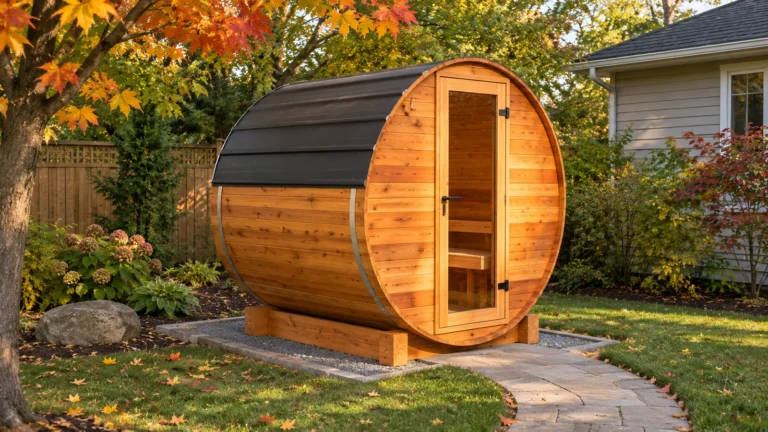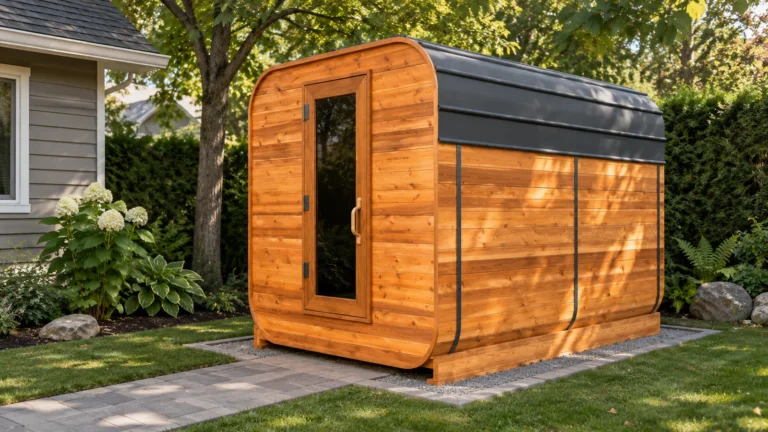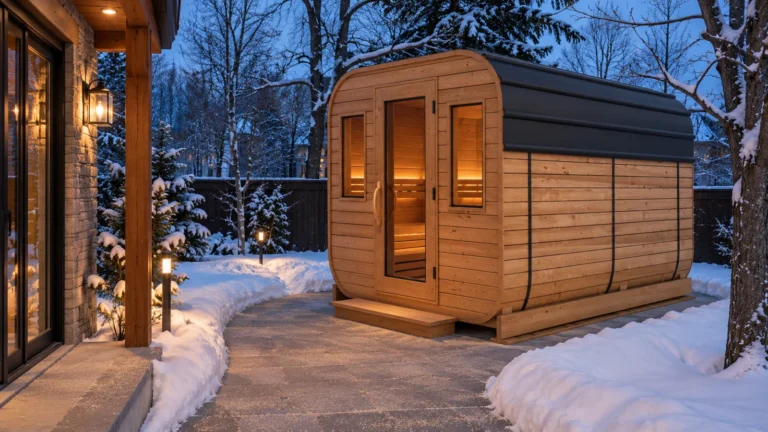

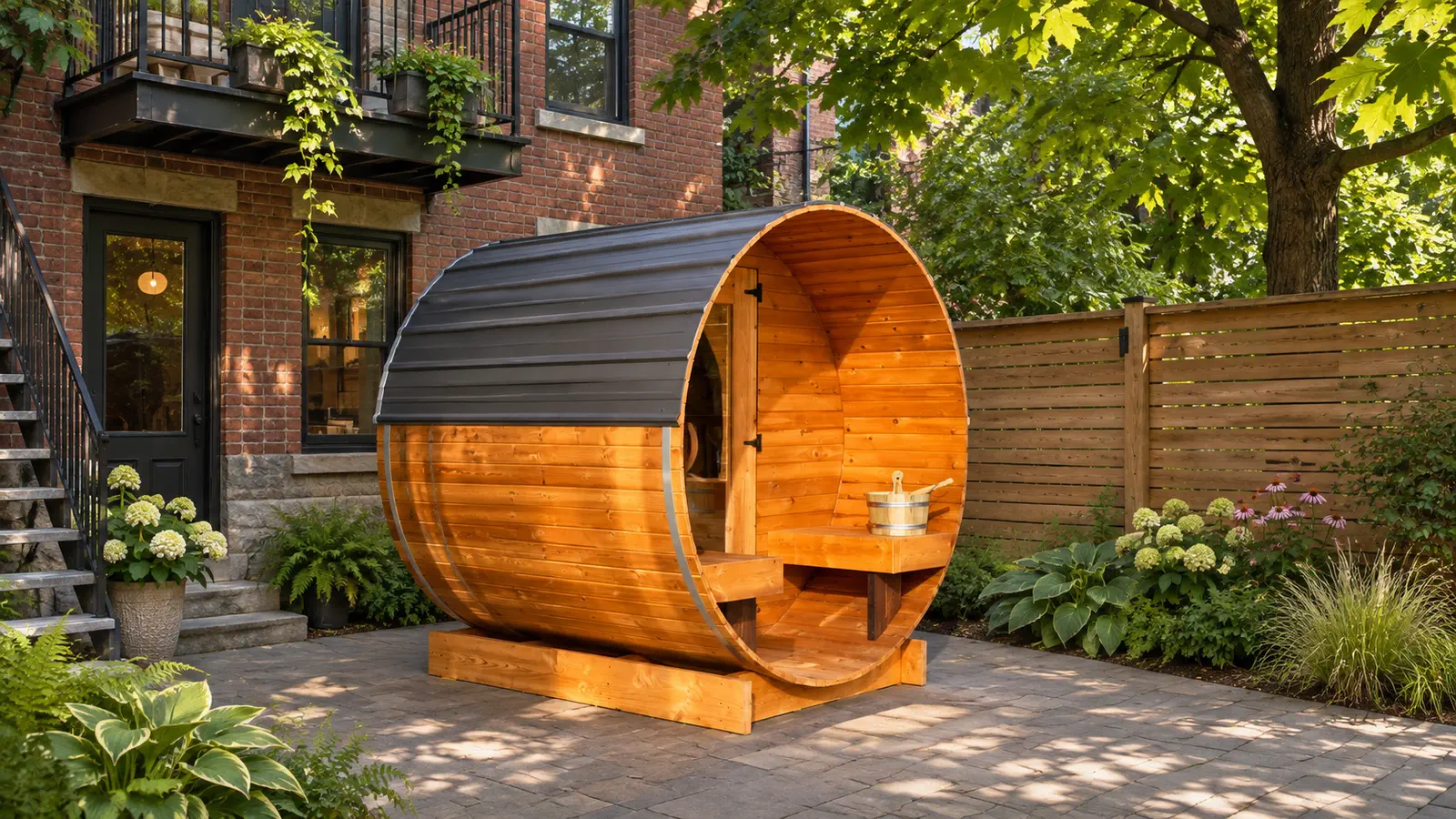
Installing an outdoor sauna in Montréal is not simply a question of whether it fits in the backyard. Across the city’s 19 boroughs, the size of an accessory structure, its position on the lot, the type of permit and even the relevance of a shed exemption can change. A compact cedar sauna is also a heated building, not necessarily a garden shed. The practical starting point is the exact address, the sauna specifications and the proposed heater.
Montréal’s official overview of sheds and outbuildings explains why owners must consult their borough before buying and installing an accessory building. This guide is for a private detached outdoor sauna associated with an existing residential property inside Ville de Montréal. It does not automatically cover neighbouring cities such as Laval, Westmount, Dorval, Montréal-Est, or a shared commercial sauna.
Can you install an outdoor sauna in Montréal?
Possibly, provided the borough accepts its use and the specific installation satisfies zoning, building, heating and safety requirements. The City describes outbuildings as detached accessory buildings serving a principal building or property. Its examples include garden pavilions, garages and spa shelters. A sauna, however, is not universally classified as a shed or given a single special permit exemption across all boroughs.
The important first question for the borough permit counter is: “How is a detached private heated sauna classified at this address?” Give the exterior dimensions, height, shape, foundation method, heater type and planned usage. Ask for the applicable bylaw provisions and, where the classification is unclear, a written answer.
Does an outdoor sauna need a permit in Montréal?
There is no reliable citywide 12 m², 15 m² or 18 m² exemption for all saunas. Some boroughs exempt certain accessory structures below local thresholds, others require a permit or authorization certificate, and some exemptions apply to a remise (shed) rather than to every detached heated building. An exemption from the building permit, when available, does not waive applicable setback, lot coverage, heritage, fire or electrical rules.
To see the difference, compare the borough-specific sections of the City’s outbuilding installation guide:
- Rosemont–La Petite-Patrie: a qualifying shed up to 12 m² and 3 m high may be installed without a permit when located in the rear yard at least 0.75 m from the house and property lines. The same page calls for a permit for other types of outbuildings. Do not assume a heated sauna is a shed.
- Saint-Laurent: the City’s page indicates an authorization certificate for a shed or other outbuilding regardless of size. Its listed general limits include a 15 m² maximum and 3.05 m maximum height, but the exact sauna classification and applicable zoning must be confirmed.
- Pierrefonds-Roxboro: the City’s general outbuilding guidance describes a permit-free case up to 14 m² and 4 m high with stated distances of 2 m from the dwelling and 0.5 m from property lines. That is not proof that every sauna qualifies, especially where heating or a particular site changes the analysis.
These examples are illustrations of different borough rules, not three approvals of sauna models. The borough could require a construction permit, authorization certificate, additional review or a project modification after examining the actual sauna.
Backyard setbacks, lot coverage and neighbouring properties
The City says accessory structures generally must respect local limits on overall lot coverage, distance to the main house, distance to property boundaries, height and location. Montréal’s overview also notes that roof drainage and snow must not discharge onto adjacent property. A narrow urban lot can have a perfectly flat area that still fails its zoning constraints.
A useful site plan should show the house and other existing structures, fences, lot boundaries, the proposed sauna footprint, overhangs, door swing, access path and the closest measured distances. Do not measure only the barrel or cube’s interior floor: the municipality may need the complete exterior footprint and projecting components. Confirm whether the relevant rule measures to a wall, roof edge, heater outlet or another element.
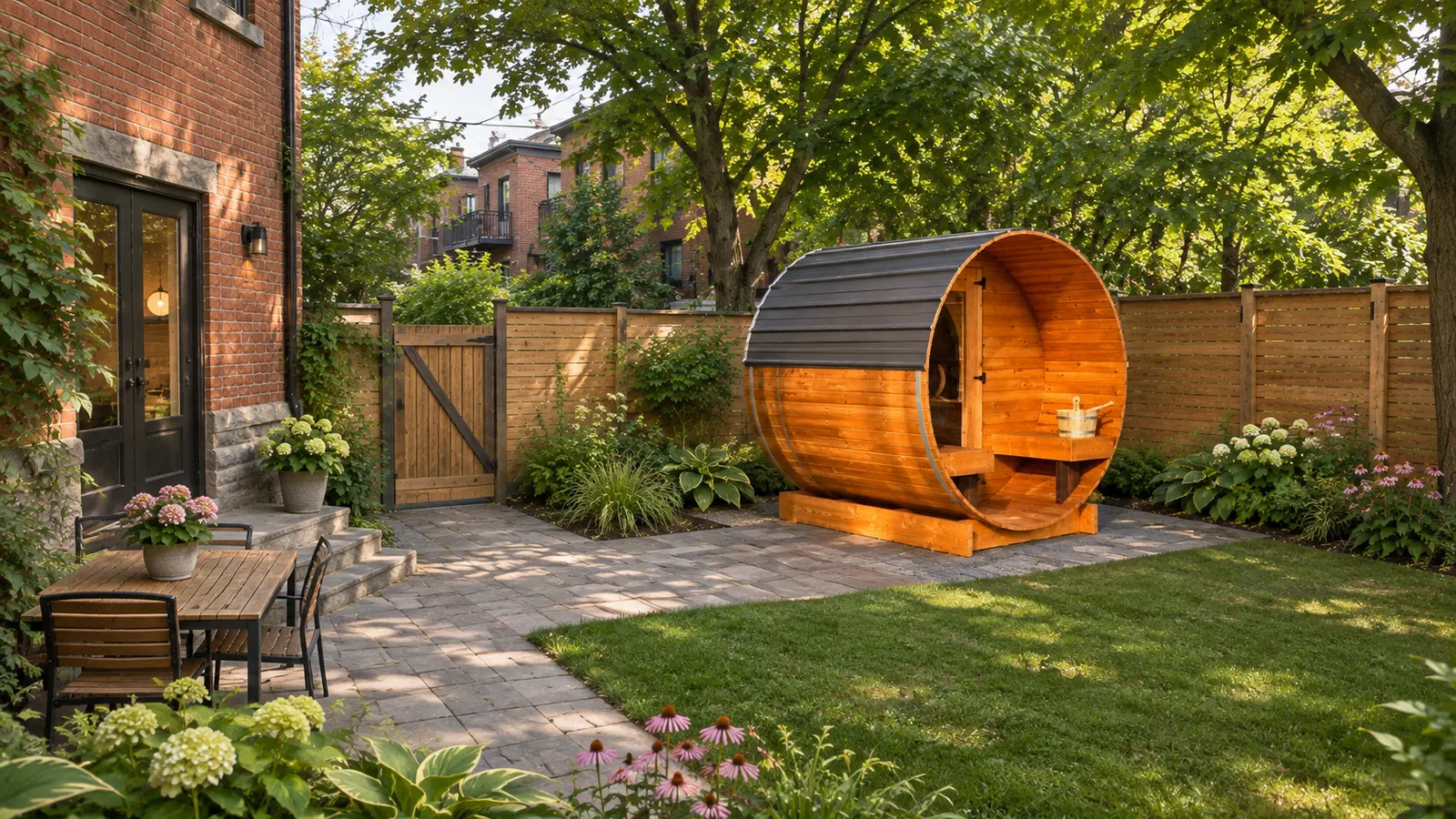
A corner lot, an alley-facing yard or a building with multiple dwelling units may raise different questions from a conventional single-family interior lot. Treat the backyard drawing as a regulatory document, not simply a landscaping sketch.
Are barrel, Cube and cabin-style saunas treated differently?
The shape and outside dimensions matter because borough rules may regulate accessory-building height, roof form, materials, architectural integration and location. A barrel roof, a Cube sauna’s flat-looking roofline and a traditional cabin sauna are not interchangeable for zoning review. No official Montréal source reviewed for this article provides a blanket approval of all three shapes.
Before selecting a final SaunaSpa model, obtain a dimensioned drawing including overall length, width, height, base/cradles, steps, roof projections and doors. For a model with a wood stove, include chimney details as a separate item. For an electric unit, include the heater’s technical sheet and the planned electrical connection.
Electric versus wood-fired outdoor saunas in Montréal
Heater choice can decide whether a proposed installation is feasible. An electric heater avoids solid-fuel smoke and chimney issues, but still requires a suitable electrical supply and code-compliant work. A wood-fired sauna faces Montréal’s unusually specific solid-fuel restrictions. Neither option overrides the local rules about the building itself.
Electric heaters
A qualified electrical contractor should evaluate the existing service capacity, dedicated circuit, outdoor wiring route and the manufacturer’s requirements for the specific heater. In Québec, electrical installation work is reserved to properly licensed contractors; the Corporation des maîtres électriciens du Québec explains the licensing requirement. Avoid promising a particular breaker size or circuit rating without reviewing the model and the existing electrical installation.
Wood-burning sauna heaters
Montréal’s solid-fuel appliance rules state that use of a solid-fuel stove or fireplace is generally restricted to models emitting less than 2.5 g of particulate matter per hour with the specified EPA or CSA certification, and that solid-fuel use is prohibited during smog warnings. The City’s stove installation permit page also addresses permits for installing, changing or removing solid-fuel appliances, followed by a declaration. These are not a ready-made approval process for every sauna stove.
A separate Montréal regulation on combustion-heating equipment in new buildings took effect progressively in 2024 and 2025 and identifies specific exceptions, including wood fireplaces authorized by municipal regulation. A small new sauna with its own wood heater is a classification question worth putting to the borough and responsible City services before ordering a stove. Do not assume an EPA label alone makes a particular sauna heater lawful, or that every new outdoor sauna with a chimney is prohibited without examining the exact provisions.
Ask the authority to confirm the model’s status, whether a new heater may be installed, what documentation and permits are needed, and which chimney, clearance and fire-protection conditions apply. If the answer is not clear, an electric-heater configuration may be easier to evaluate, but it still needs its own electrical review.
Foundations, drainage and winter access
A prefabricated sauna still needs a stable, level support suited to its actual load, dimensions, frost conditions and manufacturer instructions. Depending on the model and site, the solution may involve properly constructed gravel, paving, concrete pads or another engineered base. A universal concrete-slab requirement cannot be inferred from the City’s generic shed guidance.
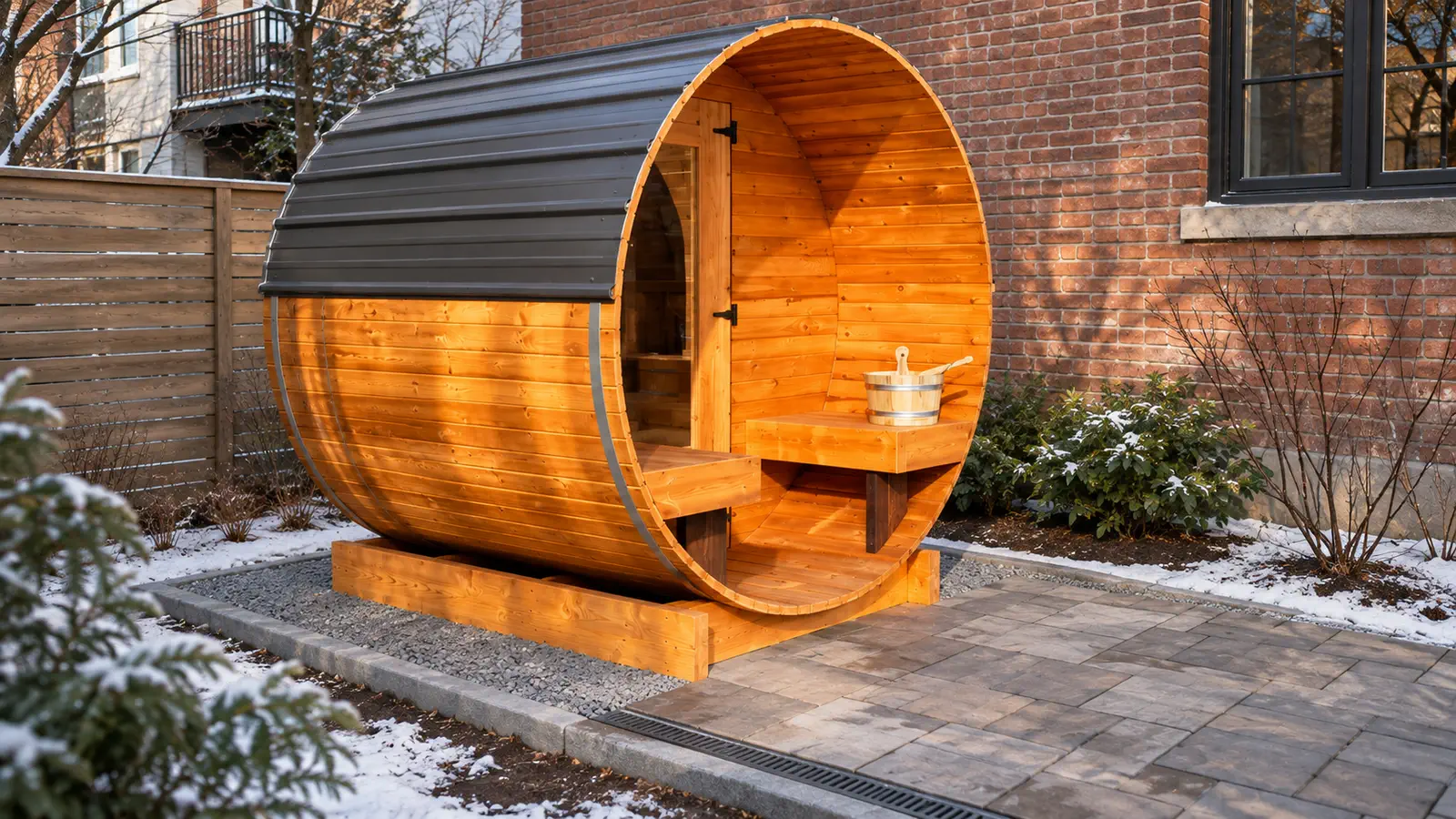
In Montréal, preserve adequate drainage and permeable surface where the borough requires it. Consider spring thaw, snow accumulation, door access, safe steps and access to the electrical connection. Do not use the neighbour’s fence as a structural support or direct roof runoff onto the adjoining lot. For a more detailed foundation, electrical and delivery sequence, see SaunaSpa’s Outdoor Sauna Installation in Canada guide.
Trees, greening, heritage and additional site restrictions
Before removing a mature tree or changing the landscape for a sauna, check Montréal’s tree-felling permit process. A permit may be necessary on private land, and tree-replacement requirements vary by borough. Protect existing roots during excavation, delivery and foundation work.
Some properties also fall within heritage areas or areas subject to a plan d’implantation et d’intégration architecturale (PIIA), where architectural review may apply. Use the City’s interactive planning maps and the borough permit counter to check the actual lot. Do not infer that an unseen backyard is exempt simply because the new structure is not visible from the street.
Delivering a fully assembled sauna to a Montréal backyard
A completed SaunaSpa unit is transported as a large object. On a tight city property, access can be a bigger challenge than choosing the sauna itself. Confirm the clear route through gates and beside the building, overhead wires, trees, balconies, stairs, alley widths and the location where the delivery equipment can safely operate.
If unloading or crane operations require temporarily occupying the street, sidewalk or other public land, the City has a separate public-property occupancy permit process. It is distinct from approval to place the sauna on private land. Plan the delivery route before pouring the base or reserving a delivery date.
What documents should you prepare for the borough?
The documents requested vary by borough, project and permit category. Montréal’s outbuilding procedure commonly refers to a certificate of location, dimensioned site plan, construction plans or manufacturer specifications, estimated costs and, where relevant, architectural integration documents.
- Full civic address, lot and borough, plus current certificate of location or surveyed property plan.
- Manufacturer’s exact model, exterior footprint, overall height, drawings and use description.
- Proposed location showing measurable distances to boundaries, the house, garages and other outbuildings.
- Heater model, fuel type, power/certification details and intended chimney or electrical route.
- Base design, drainage arrangements, proposed tree work and delivery method.
- A short written request asking whether this heated sauna qualifies for any specific outbuilding exemption.
A practical approval checklist before placing your order
- Identify the property in the correct Montréal borough; do not use a generic island-of-Montréal rule.
- Ask the borough how it classifies a detached heated sauna, not simply a storage shed.
- Confirm whether a permit, certificate, PIIA approval or other review is required.
- Check setbacks, maximum footprint and height, lot coverage, trees and stormwater drainage.
- Confirm that the proposed heater and associated installation are lawful and technically feasible.
- Verify a suitable base, gates, access, delivery clearance and any street-occupancy needs.
- Retain the municipality’s written guidance and approved drawings with your installation records.
About Montréal
Montréal, Québec’s largest city, comprises 19 boroughs on the island in the Saint Lawrence Valley. Its residential landscape ranges from attached houses with compact backyards to detached homes on larger lots. This variety explains why a single picture of a spacious backyard is a poor substitute for a property-specific check.
A private sauna can be a useful year-round amenity in the city’s climate, but in a built-up neighbourhood it needs to fit real neighbours, drainage, power supply and delivery constraints. The relevant question is not whether outdoor saunas are popular in Montréal. It is whether a particular model and placement meet the rules that apply to the address.
Where to see or buy a SaunaSpa in Montréal
SaunaSpa’s official retailer directory identifies partners in Montréal East (Tanguay L’Entrepôt Pointe-aux-Trembles), Saint-Léonard (Tanguay Jean-Talon) and LaSalle (Tanguay LaSalle), along with other Greater Montréal and Québec locations. Call the store to verify which models are physically on display: a retailer listing does not guarantee current stock or showroom inventory.
For model comparisons, delivery planning and site questions, consult the Québec showroom buying guide or contact SaunaSpa. A retailer can provide product specifications; the borough remains the authority for permits and site classification.
Frequently asked questions
Is a sauna under 15 m² permit-free in Montréal?
Not as a citywide rule. Several boroughs use size thresholds for specific accessory structures, but they are not identical and may distinguish storage sheds from other heated buildings. Have the borough classify your actual sauna.
Can I install a barrel sauna close to my fence?
Only if the borough’s applicable setbacks and the installation’s fire, access, drainage and other restrictions allow it. The correct distance is not necessarily the same across boroughs or structures.
Can I use a wood-burning sauna stove?
Do not buy one based solely on its advertised certification. Montréal regulates new solid-fuel installations and appliance emissions. Confirm whether the specific model is eligible and which permits or declarations apply, particularly for a new detached heated structure.
Does a prefabricated sauna avoid building permits?
No blanket exemption was established. A factory-built sauna is still an accessory installation whose use, dimensions, location and heater may trigger municipal review. The absence of a poured foundation does not itself settle the issue.
Does this guide cover Laval, Westmount or other island municipalities?
No. Those are separate municipal jurisdictions. This guide addresses the 19 boroughs of Ville de Montréal only. Verify the applicable city when the address falls elsewhere.
Outdoor sauna planning in Montréal: what matters most
For a Montréal homeowner, the efficient order is borough and classification first; placement and heater second; model, base and delivery third. Treat an exemption for garden storage as a clue to investigate, not an automatic answer for a heated sauna. Montréal’s solid-fuel provisions deserve particular attention before choosing a wood-fired design.
Start with the correct municipal outbuilding guidance, check the property’s planning context and gather the model specifications for a written borough inquiry. The result should be a practical installation plan, not a guess based on the neighbour’s shed.
Regulatory note: This independent commercial guide was researched against Ville de Montréal guidance available on November 23, 2026, including the borough outbuilding procedure, zoning, solid-fuel heating and new-building combustion rules. No sauna-specific blanket exemption or wood-heater authorization was established by these sources. The City may update rules and individual properties may have special provisions. Seek current written confirmation for the proposed location and heater before installation.